
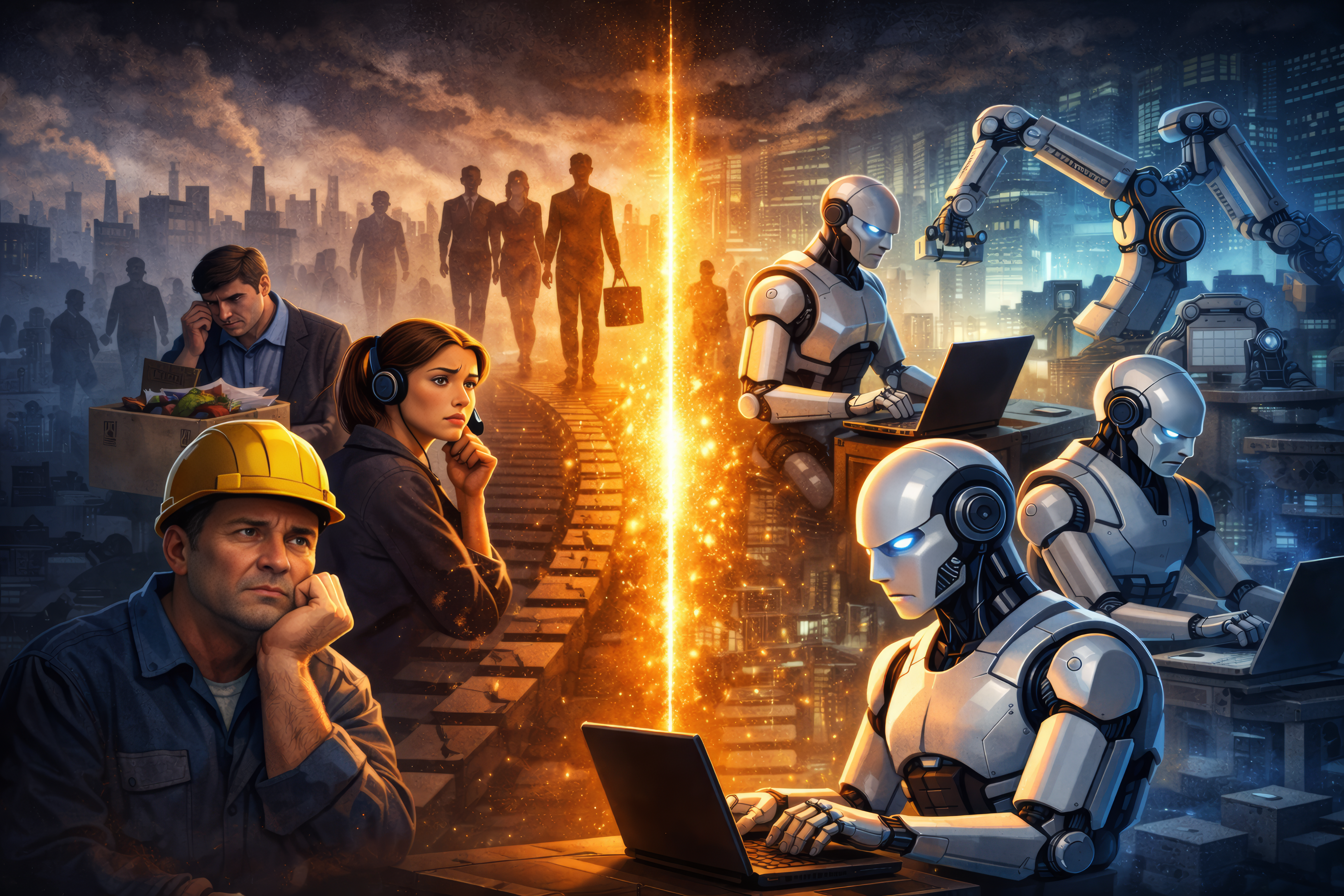
Will AI steal our jobs?
Separating fear from reality in the conversation around AI, automation, and the future of jobs.
Imagine this. It is a random Tuesday in 2028. Your phone rings before you are even pretending to be productive. On the other end is a calm voice from payroll saying, “Hi, just a heads up. The robots ate the payroll.” Yikes. Your coffee suddenly tastes like betrayal. Your inbox feels personal. Even the printer sounds a little smug.
Panic sets in immediately. Is this how it happens? Not with some dramatic robot uprising, but with one bland little phone call before 9 a.m.? Did the robots finally eat the jobs and leave the rest of us scrambling for relevance, income, and a backup plan?
But is that actually reality?
Let’s start with the real answer, not the dramatic one. AI is not going to wipe out every job overnight. It is also not harmless. Both extremes are lazy and, frankly, perfect fuel for the social media machine that turns fear into clicks.
The truth is simpler and more perhaps more mundane, yet uncomfortable. AI is going to change a lot of jobs, speed up a lot of work, remove some roles, shrink others, and raise expectations almost everywhere.
That is the part people keep dancing around. Most jobs are not one thing. They are a pile of tasks. Some of those tasks are repetitive, predictable, and honestly kind of begging to be automated. Others require judgment, context, accountability, trust, and the ability to deal with messy human reality. AI is getting very good at the first group. It is still nowhere near as dependable on the second.
So no, the smarter question is not “Will AI take my whole job?” The smarter question is “Which parts of my job are easy to automate, and what happens when those parts stop being worth paying a person to do?” That is where the real pressure is. Not in some sci-fi robot takeover. In the slow removal of low-value, repeatable work that a lot of businesses have been tolerating for years.
Most jobs will not vanish. They will shift.
That sounds less exciting than the doom headlines, but it is closer to reality. Research from the International Labour Organization found that generative AI is more likely to transform jobs than erase them outright, even in roles with meaningful exposure.[1] The World Economic Forum tells a similar story. Its 2025 report projects major job disruption by 2030, but still expects a net gain in total jobs globally as new roles are created while others are displaced.[2]
Translation: work is moving. Some roles will get thinner. Some will get faster. Some will get rebuilt around different skills. Some companies will absolutely use AI to cut labor where they think they can. That part should not be sugarcoated. But a lot of the actual change will show up as job redesign, not job extinction.
That is still a big deal, by the way. If the job stays but the expectations double, that is disruption. If one person can now do the output that used to take three people, that is disruption. If the entry-level version of a role starts disappearing because AI can handle the beginner tasks, that is disruption too. It does not have to look like mass layoffs with robot theme music to matter.
AI is coming for tasks first, not entire professions
This is where the conversation gets clearer. AI is strongest when the work is structured. First drafts. Summaries. Documentation. Data cleanup. Categorization. Status updates. Pattern recognition. Admin work. Inbox triage. Basic analysis. Rewriting the same thing six slightly different ways because five stakeholders needed to feel involved.
That kind of work is all over modern businesses. Which is why this is hitting white-collar teams so directly. Previous waves of automation hammered physical repetition. This wave is going after cognitive repetition. That feels different because a lot of people built careers around being the one who could manage the process, clean up the mess, or keep the machine moving manually. Now the machine is learning some of those moves.
What AI still struggles with is the stuff that is harder to fake. Real judgment. Real ownership. Real nuance. Managing clients when the answer is messy. Navigating politics inside an organization. Making a call when the data is incomplete and the stakes are real. Leading people. Building trust. Catching when something sounds polished but is actually wrong. AI can assist with that work. It cannot truly own it.
The real risk is uneven impact
Not everybody is getting hit the same way, and that matters. Research from the IMF shows that AI exposure is often higher in advanced economies and in more office-based, cognitive jobs.[3] That does not automatically mean those workers lose. In many cases, they benefit because AI boosts productivity. But it does mean the pressure shows up in new places.
One of the biggest issues is at the lower end of the ladder. A lot of people start their careers doing task-heavy work. The boring stuff. The repeatable stuff. The work that teaches you the business before you move into judgment-heavy roles. If AI strips out too much of that entry-level layer, then the problem is not just job loss. The problem is fewer on-ramps. Fewer ways to get in. Fewer ways to build experience. That is a serious issue, and it deserves more attention than another dramatic headline about robots replacing humanity by lunch.
Some of the panic is stupid. Some of it is justified.
The panic gets ridiculous fast. Every time a new model drops, somebody acts like payroll is about to collapse by Friday. That is nonsense. Businesses do not transform that fast, and most of them are still tripping over basic process problems they should have fixed years ago.
But some of the concern is absolutely justified. Companies are not adopting AI out of pure scientific wonder. They want speed. They want leverage. They want lower operational drag. They want fewer bottlenecks. And yes, some want to reduce labor cost. That is reality. Anyone pretending otherwise is either naive or selling something.
The problem is that a lot of leaders still think “using AI” means throwing a chatbot at a broken process and calling it innovation. It does not. If your workflow is a mess, AI usually helps you produce a faster mess. If your data is bad, your outputs are still bad, just shinier. If no one is accountable for reviewing what the model produces, you are not transforming the business. You are scaling polished nonsense.
The people most at risk are not always the people shouting the loudest
AI does not just threaten obviously repetitive jobs. It also pressures people whose value has quietly depended on being the bridge between messy information and usable output. If your whole role is collecting, rewriting, organizing, summarizing, or repackaging information in a predictable way, you should be paying attention. That does not mean panic. It means honesty.
At the same time, people with strong domain knowledge, strong communication, strong judgment, and the ability to actually improve a process are in a much better position. The future is not just “learn AI.” That is too vague to be useful. The real play is to become harder to replace because you understand both the work and how to use the tools around it.
In plain terms, the competition is often not “human versus AI.” It is “human using AI well versus human doing everything the long, manual, painful way and hoping nostalgia becomes a business strategy.” That usually does not end well.
What can companies and individuals do now?
First, stop treating AI like a party trick or a panic button. For companies, responsible adoption starts with identifying where work is actually slow, repetitive, inconsistent, or too dependent on manual effort. That means looking at workflows, handoffs, reporting, support volume, documentation, internal requests, and the kind of low-value admin work that quietly eats time across the business. The companies getting the most value from AI are not just handing people tools and hoping for magic. They are redesigning workflows, setting governance, and staying involved in how the work changes. McKinsey’s 2025 State of AI research found that workflow redesign was the single biggest factor tied to bottom-line impact from generative AI.
That also means leaders need to think carefully about role redesign, not just cost cutting. If AI can handle part of a role, the question should not automatically be, “How fast can we reduce headcount?” A better question is, “What higher-value work should this role be freed up to do now?” That could mean more client attention, faster response times, better quality control, stronger analysis, cleaner execution, or more strategic ownership. The World Economic Forum’s 2025 report projects significant job disruption through 2030, but it also projects substantial job creation and growing demand for skills like analytical thinking, resilience, flexibility, leadership, and creative thinking.
For individuals, the move is not denial and it is not blind hype. Learn the tools, yes, but also learn where they fail. Learn how to validate output, improve process, and bring judgment to the work. If AI is getting better at first drafts, summaries, categorization, and other structured tasks, then your advantage shifts toward interpretation, decision-making, communication, problem solving, and knowing how to use the technology without being carried by it. The IMF’s work on generative AI and labor markets makes that tension clear: exposure is rising, especially in more cognitive roles, but the effect depends heavily on whether AI complements human work or replaces parts of it.
For businesses that are serious about adopting AI responsibly, this is usually where an outside assessment helps. Not because every company needs some dramatic transformation program, but because most teams are too close to their own processes to see clearly where the real friction is, what should be automated, what should stay human-led, and what is simply broken upstream. A good assessment should help you identify where AI can remove drag, where role expectations need to shift, where governance matters, and where buying another tool would just decorate the problem instead of solving it.
That kind of work is less about chasing trends and more about making smarter decisions before money gets spent and teams get disrupted for no reason. If your organization is trying to figure out where AI actually fits, where it creates value, and how to move without making a mess, a Business Technology & AI Assessment is a practical place to start.
So, will AI steal our jobs?
Some of them, yes. Or at least pieces of them. That is the honest answer. But the bigger truth is that AI is changing the shape of work faster than a lot of people are ready for. It will remove some tasks, compress some teams, create some roles, and force a lot of workers and businesses to rethink what actually makes a person valuable.
The takeaway is not panic. It is not denial either. It is adaptation. Learn the tools. Learn the risks. Get better at the parts of work that actually matter. Because the people most likely to get squeezed are not always the least talented. A lot of times, they are just the ones doing work a machine can now do faster, cheaper, and with fewer complaints about calendar invites.
Ready to start a conversation?
BOOK NOWReferences
- International Labour Organization, Generative AI and jobs: A 2025 update, May 2025.
- World Economic Forum, Future of Jobs Report 2025, January 2025.
- International Monetary Fund, Gen-AI: Artificial Intelligence and the Future of Work, January 2024.