
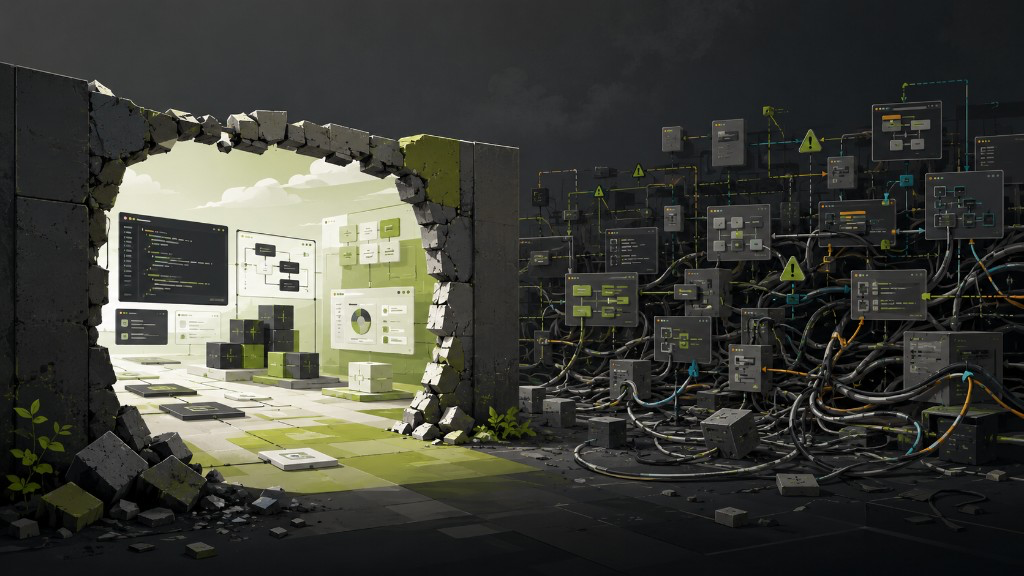
The Barrier Is Gone. The Fundamentals Still Matter.
AI has made building software more accessible than ever. That is a good thing. But speed without understanding can create a mess faster than ever, too.
Not long ago, creating software meant learning syntax, frameworks, databases, hosting, deployment, architecture, security, debugging, and a whole bunch of other things that made most people quit before they ever got something working.
Now? You can describe what you want, paste a prompt into an AI tool, and get something that looks like a working product in minutes.
That shift is not small. It is not just “interesting.” It is borderline earth-shattering. And honestly, it is awesome.
More people can build now. Business owners can prototype internal tools. Operators can automate annoying workflows. Junior developers can learn faster. Experienced developers can move quicker. People who used to be completely locked out of software creation can finally start turning ideas into something real.
That is a good thing. But because the universe refuses to let us have anything nice without a weird catch, it also creates a new problem: just because you can build something faster does not mean you understand what you built.
And that is where the fundamentals still matter.
Access is not the same as understanding
AI coding tools are not fake. They are not just hype. They can absolutely help people move faster. GitHub and Microsoft research on Copilot found that developers using the tool completed a coding task 55.8% faster than developers who did not use it. So no, this is not an anti-AI rant. I am not standing on a digital lawn yelling at the robots. These tools are useful, powerful, and in a lot of cases, genuinely impressive.
Use them. Prototype faster. Learn faster. Automate the boring stuff. Get unstuck. Turn a blank screen into a starting point. That alone is a massive win.
But access is not the same as mastery. There is a difference between getting something to appear on a screen and understanding what you actually built. That difference used to be more obvious because the process was slower. If you were writing the code yourself, you had to wrestle with the logic piece by piece. You had to make decisions. You had to feel the pain of your own bad assumptions.
Now the tool can fill in a lot of those blanks. It can generate the code, explain the error, suggest a fix, restructure the function, build the interface, and make you feel like you just skipped five steps. Sometimes you did. Sometimes you skipped five steps that really should not have been skipped.
That is the tension. AI lowered the barrier to building. It did not lower the consequences of building poorly.
Vibe coding is useful, until it pretends to be more than it is
I do not hate vibe coding. For the right use case, it can be great. If you are prototyping an idea, learning something new, building a throwaway tool, testing a workflow, or trying to get something out of your head and onto a screen, AI can be incredibly useful. There is real value in being able to move quickly before you spend a bunch of time, money, and energy on something that might not even make sense yet.
Sometimes you just need to see the thing. Sometimes you need momentum. Sometimes you need to get the idea out of your head before it dies in a notes app graveyard next to “new business idea,” “gym plan,” and “podcast concept.” That is practical.
The problem starts when a prototype starts dressing up like a production system. A quick internal tool becomes part of the daily workflow. A small script becomes the thing everyone depends on. A generated app starts handling real data. A “temporary fix” becomes business infrastructure because nobody wants to touch it anymore.
Every developer has seen some version of this. The thing that was “just for now” somehow becomes permanent. Then six months later, everyone is scared to change it because nobody fully understands how it works.
AI does not remove that problem. It can speed it up. That is why “it runs” cannot be the finish line. A button clicking successfully does not mean the system is secure. A page loading does not mean the data model makes sense. A script finishing once does not mean it will behave correctly every day when someone’s payroll, inventory, sales report, invoice, customer record, or operations workflow depends on it.
It runs. Great. Now what?
That is where the real work begins.
Even the AI companies are telling you to review the work
One of the strongest arguments for using judgment with AI-generated code is that the companies making these tools are saying the same thing. GitHub’s own responsible-use documentation for Copilot says it should be used as a tool, not a replacement for human programming. It also says developers should review generated code before accepting a suggestion, then validate it afterward to make sure it meets requirements and is free of errors or security concerns.
That is not some anti-AI person being dramatic. That is GitHub talking about its own product.
GitHub gives similar guidance for Copilot Chat, warning that generated code should be reviewed and tested. OpenAI says ChatGPT can produce incorrect or misleading outputs and may sound confident even when it is wrong. That matters in writing, research, planning, and absolutely in software. A confident answer can still be wrong. A clean-looking function can still be broken.
Google is leaning heavily into AI-generated code too. Sundar Pichai said in 2024 that more than 25% of new code at Google was being generated by AI and then reviewed and accepted by engineers. The part people should pay attention to is not just “AI-generated.” It is “reviewed and accepted by engineers.”
That is the grown-up version of AI-assisted development. Use the tool. Move faster. Let it help. Then review it, test it, understand it, and own it. AI can generate the draft. It cannot take responsibility for what happens after it ships.
The hard part is shifting
For a long time, one of the biggest software questions was simple: can you write the code? That question still matters, but it is no longer the whole conversation. Now the harder question is whether you understand what the code is doing.
Can you tell if it is solving the right problem? Can you tell if it is handling data correctly? Can you tell if it is exposing something it should not? Can you tell if the logic is quietly wrong? Can you tell if it will be maintainable later, or if it is just today’s success becoming next quarter’s headache?
That is where fundamentals matter. Not because every person using AI needs to become a senior engineer overnight. That is not realistic, and it is not the point. The point is that fundamentals give you the ability to ask better questions.
Problem definition matters because building the wrong thing faster is still building the wrong thing. Data structure matters because bad data decisions have a way of becoming business problems with better branding. Security matters because “the AI wrote it” is not a strategy, and it is definitely not something you want to say out loud after customer data ends up somewhere it should not.
OWASP’s work around generative AI security exists for a reason. The security world is not treating AI-driven applications, LLMs, and agentic systems like a cute little side quest. Neither should businesses.
Testing matters because clicking around once and feeling good about it is not the same thing as knowing it works. Architecture matters because small decisions have a funny way of becoming permanent. A shortcut here, a weird workaround there, and suddenly your “simple tool” is a fragile little tower of duct tape with a login screen.
Maintainability matters because someone has to come back later and understand the thing. That someone may be you, and future you deserves better than a mystery folder named “final-final-new-actual.” User experience matters because if the tool is annoying, confusing, or slower than the old process, people will avoid it. They will go right back to spreadsheets, side texts, sticky notes, and the sacred company tradition of “just ask Sarah, she knows where everything is.”
The fundamentals are not there to slow everything down. They are there to keep speed from turning into chaos.
Trust is still very much an issue
There is a reason experienced developers are cautious with AI output. Stack Overflow’s 2025 Developer Survey found that more developers actively distrust the accuracy of AI tools than trust them. Forty-six percent said they distrust AI tool accuracy, compared with 33% who trust it. Only a small fraction said they highly trust the output.
That is not fear of the future. That is pattern recognition. People who have lived with production systems know that software does not get graded on how convincing it looks. It has to work under real conditions, with real users, real data, real exceptions, real edge cases, and real business consequences.
Sonar’s 2026 research points to the same problem from another angle. Their report found that 96% of developers do not fully trust AI-generated code to be functionally correct, yet only 48% say they always verify AI-assisted code before committing it. Sonar called this a “verification gap,” which is a very polite way of saying, “A lot of people know this stuff needs to be checked, but not everyone is checking it.”
That is where the risk starts to get real. The issue is not just that AI can be wrong. People can be wrong too. The issue is that AI can produce a lot of wrong very quickly, and it can do it in a way that looks polished enough to sneak past people who are moving too fast.
Sonar’s reporting also noted that 61% of developers say AI often produces code that looks correct but is not reliable. That is the exact danger zone. Not the broken code that immediately explodes and announces itself. The polished code. The confident code. The “looks good to me” code that quietly drags problems behind it.
That creates a new kind of risk. Not the obvious kind where everything breaks immediately and everyone knows there is a problem. The quieter kind. The kind where the code works well enough during the demo, but nobody checked the edge cases. The kind where the automation saves time until it mishandles the weird scenario that happens twice a month. The kind where the workflow looks cleaner, but now the team is depending on something nobody really owns.
That is not progress. That is technical debt with better marketing.
AI does not make experts less valuable
One of the stranger assumptions floating around is that if AI can write code, expertise matters less. I think that misses the point completely.
AI makes shallow output easier to produce. It does not make good judgment less valuable. If anything, it makes good judgment more valuable because now there is more output to judge.
When the blank page disappears, the bottleneck moves. It moves to deciding what should be built. It moves to knowing what should not be built. It moves to understanding the business process behind the request. It moves to reviewing the code. It moves to spotting risk. It moves to connecting systems properly. It moves to making tradeoffs that a model cannot fully understand because it does not live inside your business.
That is where experienced people matter. An expert is not just someone who can type code without help. An expert is someone who can look at a request and say, “That sounds simple, but here is where it gets messy.” Or, “We can automate that, but we need to clean up the data first.” Or, “AI can help with this part, but this other part needs a normal integration.” Or, “We should not build this yet because the process itself is broken.”
Or, my personal favorite, “Yes, we can technically do that. No, we should not.”
That is not gatekeeping. That is protecting the outcome. AI can help create options. It can help with drafts. It can speed up repetitive work. It can make skilled people faster and less-skilled people more capable. But it still needs direction. And the better the direction, the better the result.
This applies outside of software too
This is not only about developers. The same lesson applies to businesses using AI for operations, automation, reporting, marketing, customer service, internal tools, and process improvement.
The danger is not that people use AI. The danger is that people use it without understanding the workflow underneath it. If a process is already messy, AI may just help you make the mess faster. If your data is inconsistent, AI does not magically make it reliable. If your team does not understand who owns what, adding another tool may just create one more place for work to disappear.
That is why the starting point still matters.
- What problem are we solving?
- What does the current process look like?
- Where is time being wasted?
- Where are errors happening?
- What information matters?
- Who needs to use this?
- What happens if it fails?
- What should stay manual?
- What should be automated?
- What needs AI, and what just needs a cleaner system?
Those questions are not as flashy as a demo video where an app appears in thirty seconds, but they are usually the questions that decide whether the work actually creates value.
Use AI, just do not turn your brain off
Ignoring AI is a bad plan. Blindly trusting AI is also a bad plan. The smarter path is somewhere in the middle, and it is a lot less dramatic than the internet wants it to be.
Use AI to move faster. Use it to explore ideas. Use it to prototype. Use it to write first drafts, explain errors, generate options, and reduce the tedious parts of the work. Then slow down where it matters.
Review the code. Test the workflow. Check the assumptions. Understand the data. Think about security. Think about maintenance. Think about the people who have to use the thing after the exciting demo is over.
The barrier to building is lower than it has ever been. That is exciting. But the fundamentals still matter because they are what keep that speed pointed in the right direction.
AI can help you build. Judgment helps you build something worth keeping.
The bottom line
AI has made building software more accessible, and that is a good thing. More people can create, test, automate, and prototype than ever before. But the easier it gets to build, the more important it becomes to understand what is actually being built.
That does not mean every business owner, casual user, or AI-assisted builder needs to become a full-time software engineer. It means the basics still matter. The workflow matters. The data matters. The security matters. The handoff matters. The maintenance matters. The human judgment around the tool still matters.
AI can reduce friction. It can speed up the first draft. It can help people move from idea to execution faster than ever. But it does not remove accountability.
For businesses, that means the goal should not be to blindly chase AI or avoid it out of fear. The goal should be to use it where it makes sense, with enough structure and understanding to avoid creating more mess behind the scenes.
Because the barrier may be gone. But the fundamentals are still what keep the work from falling apart.
If your team is trying to make sense of where AI, automation, or broader technology changes actually fit, the smartest starting point is usually not another demo. It is a clearer view of the business itself. That is where thoughtful assessments, workflow reviews, and outside perspective tend to create the most value: not by adding noise, but by helping teams cut through it.
Ready to start a conversation?
BOOK NOWReferences
- GitHub, Research: quantifying GitHub Copilot’s impact on developer productivity and happiness .
- Microsoft Research, The Impact of AI on Developer Productivity: Evidence from GitHub Copilot .
- GitHub Docs, Responsible use of GitHub Copilot inline suggestions .
- GitHub Docs, Responsible use of GitHub Copilot Chat in GitHub .
- OpenAI Help Center, Does ChatGPT tell the truth? .
- Stack Overflow, 2025 Developer Survey: AI .
- Sonar, Sonar Data Reveals Critical “Verification Gap” in AI Coding .
- ITPro, Software developers not checking AI-generated code risk verification debt .
- OWASP, OWASP Top 10 for Large Language Model Applications .
- Alphabet, Alphabet Q3 2024 Earnings Call .